
In Huizinga’s essay on the “Nature and Significance of Play in Culture”, he introduces his stance on play by stating, “Play is older than culture, however inadequately defined, always presupposes human society…” (1). Play is manifested in everyday life whether we know it or not, and is an important part of culture and the functioning of society. Huizinga also establishes a difference between the activities of play and fun. One can play in a variety of situations, and ways. Fun does not need to be present when play is in action. Depressionquest, an online game created by Zoe Quinn, Patrick Lindsey, and Isaac Schlanker, can attest to this. 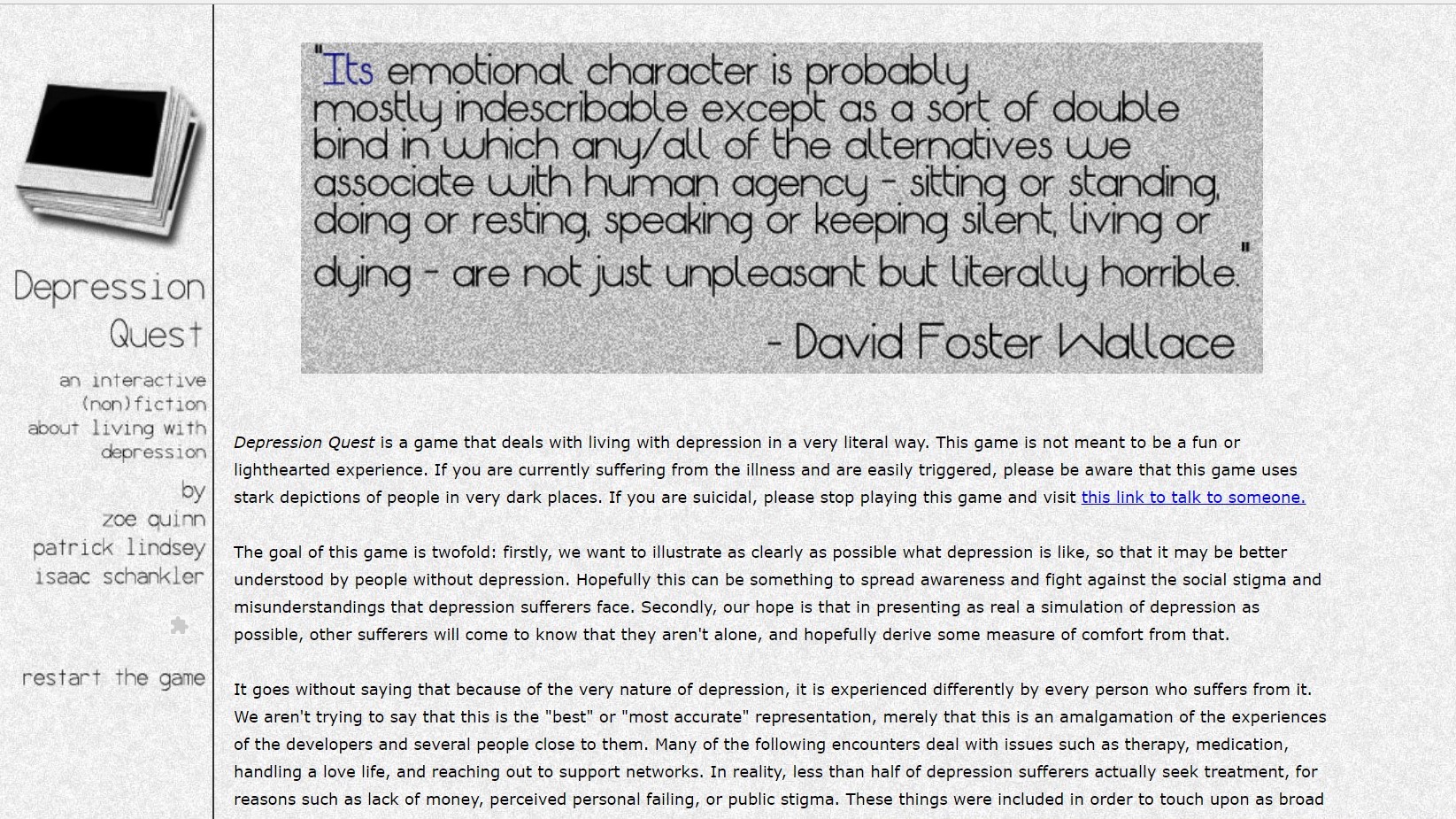
Depression and fun are not two words that are typically associated with one another. One may need to expand their knowledge on the term play before understanding depressionquest. When someone creates a game based on depression, it may raise a few questions, because society’s initial association with games, is fun. The creators of this game made sure to include an introduction which clarified their reasoning behind producing it, stating that it is not meant for fun, but for learning and awareness purposes. Playing depressionquest may not help someone who has depression, but playing it will give others a better understanding of what it’s like to live with this condition and experience the mental processes of what someone with depression may experience (Counter 1). Below is a video of YouTube vlogger whose channel is named, Folding Ideas, contextualizing depressionquest and using other popular video games to help the audience understand the complexity of the play of depressionquest, and how it contains all of the same elements of other video games.
“When gamers are completely focused on playing, they tend to forget all other things around them”- Youngkyun shares this thought in the Preface of his book, Psychology of Gaming. However, this statement can apply to everyday activities, and to people who do not necessarily consider themselves as ‘gamers’. Games may enhance motivational and attentive qualities in a person, but whether one is on the couch with a controller in hand, or at a desk with a pen in hand, these actions both share a motivation to achieve an end goal, and go through obstacles to obtain it.
In Eric Zimmerman’s manifesto, he states something interesting about games and play – “Games like Chess, Go, and Parcheesi are much like digital computers, machines for creating and storing numerical states. In this sense, computers didn’t create games; games created computers”. Play, which is mostly associated with games, is what allows humans to question and create systems such as computers that contain a variety of mechanisms and possibilities, like the game of Chess. There are many different mechanisms in the game Chess as there are in the process of creating and playing.
